
In a nutshell:
Consistency isn’t hard because you’re lazy.
It feels impossible because your nervous system is overloaded.
When your body is in survival mode, your brain prioritizes protection — not performance.
This post will help you understand:
• Why discipline fails under stress
• Why pushing harder backfires
• What actually creates sustainable consistency
Signs your nervous system is exhausted (you may notice this)
If:
• You start routines but can’t maintain them
• Simple tasks feel heavier than they should
• You feel motivated mentally but can’t follow through physically
• Rest doesn’t fully restore your energy
• You feel stuck between wanting change and lacking capacity
This isn’t laziness.
It’s a nervous system overload.
This isn’t a discipline problem
If you’ve ever thought:
“Why can’t I just stick to anything?”
This is for you.
You don’t struggle with consistency because you lack ambition. You struggle because your system is overloaded. There’s a difference between being unmotivated and being dysregulated.
Most women aren’t lazy. They’re overstimulated, under-rested, and running on survival mode. And survival mode doesn’t care about your to-do list.
Why consistency fails under stress
Let’s get physiological.
When you’re under prolonged stress, your nervous system shifts into protection mode.
That means:
1. Survival mode overrides growth mode
Your brain focuses on:
• Immediate threats
• Emotional safety
• Energy conservation
Habits require repetition and cognitive space.
Stress consumes both.
Your system isn’t resisting consistency.
It’s protecting your remaining energy.
2. Cognitive load increases
When you’re overwhelmed:
• Decision fatigue spikes
• Executive function drops
• Follow-through decreases
It’s not that you don’t want to do the routine.
Your mental bandwidth is maxed out.
Consistency requires margin.
Stress removes margin.
3. Emotional depletion drains follow-through
When your nervous system is tired:
• Small tasks feel heavy
• Minor setbacks feel catastrophic
• Motivation collapses faster
This isn’t weakness. It’s biology.
Your nervous system determines your capacity.
Not your intentions.
Why this becomes a cycle you can’t break
Maybe you’ve tried already.
You’ve created routines before.
You’ve written the lists.
Bought the planner.
Promised yourself this time would be different.
And for a few days, it was.
Until your energy dropped.
Until life happened.
Until your nervous system needed recovery.
And suddenly, the routine felt impossible again.
Not because you failed. But because the system wasn’t built for your capacity.
Most routines are designed for your best days.
Not your exhausted ones.
So when your energy fluctuates, the structure collapses. Not because you’re incapable.
Because the system was never sustainable.
Why traditional discipline advice backfires
Here’s where most get it wrong.
You’re told:
• “Be more disciplined.”
• “Wake up earlier.”
• “Just push through.”
• “No excuses.”
But pushing through dysregulation increases shutdown.
Discipline without regulation:
• Pushes past capacity
• Increases nervous system stress
• Reinforces guilt loops
So you:
- Try harder
- Crash
- Feel ashamed
- Restart
- Repeat
That cycle isn’t a character flaw.
It’s a structural problem.
What actually works instead
You don’t need intensity.
You need regulation first.
Consistency becomes possible when routines feel safe — not demanding.
Here’s what changes everything:
1. Nervous-system-safe routines
Instead of:
• 10-step morning routines
• Hour-long resets
• All-or-nothing systems
You create:
• 1–3 anchor habits
• Low-resistance actions
• Rhythms you can complete even on low-energy days
Consistency grows from safety.
Not pressure.
2. Smaller rhythms
Consistency is not intensity. It’s repetition.
A 5-minute daily reset you actually complete is more powerful than a 60-minute routine you abandon.
Sustainable systems reduce friction.
They work with your nervous system — not against it.
3. Capacity-based structure
Before building habits, ask:
• What is my actual energy capacity right now?
• What can I repeat at 60% effort?
• What would feel supportive instead of punishing?
Structure should stabilize you — not strain you.
A gentle reset you can try right now
Before reading further, pause.
Take one slow breath.
And ask yourself:
What is one small action that would feel supportive right now — not productive?
Not impressive. Supportive.
Maybe it’s:
• Drinking water
• Stepping outside
• Closing your eyes for 30 seconds
• Clearing one small surface
Consistency begins with safety. Not pressure.
This is how a safe nervous system structure starts.
Why insight alone isn’t enough
Understanding this changes everything.
But understanding alone doesn’t create consistency.
Because when you’re already exhausted, designing a gentle structure from scratch feels like another task.
You now understand why pushing harder doesn’t work. But what does safe consistency actually look like day to day?
How do you structure it? How do you avoid slipping back into intensity cycles?
This is where most people fall back into trial and error.
Not because they lack discipline.
Because they lack a nervous-system-safe framework.
This is why having a gentle, structured system already designed for nervous system recovery makes the process easier.
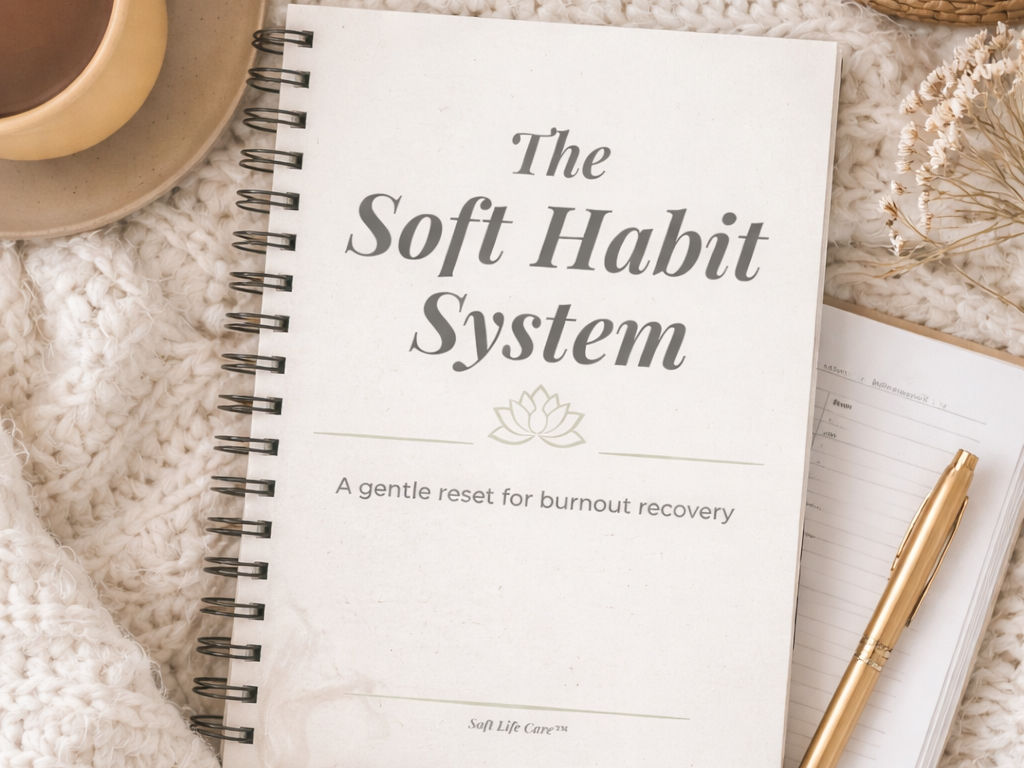
The Soft Habit System for Burnout Recovery was created specifically to help you rebuild consistency safely, without forcing yourself into routines your system can’t sustain.
The missing piece isn’t motivation. It’s structure.
You don’t need more motivation.
You need a structure that respects your nervous system.
That’s exactly why I created the Soft Habit System for Burnout Recovery.
It’s a gentle framework designed specifically for:
• Low-energy seasons
• Overstimulated minds
• Women recovering from burnout
• Anyone who wants consistency without self-punishment
Inside, you’ll find:
• A simple system to rebuild consistency safely
• Gentle habit anchors designed for low-capacity days
• Supportive rhythms that stabilize your nervous system
• A structure you can maintain even when motivation disappears
So you stop restarting. And finally experience what sustainable consistency feels like.
If your nervous system has been seeking a softer approach, this is where it begins.
[ Explore the Soft Habit System for Burnout Recovery ]
Gentle structured. Sustainable consistency. Nervous system safety.
 Soft Life Care